On-site chiropractic care, delivered to the shop floor on a cadence built for your team.
The table goes where the team is. We work through your crew during a single window, fix what we can fix in 10 to 15 minutes per person, and put the same provider in front of them next month. No clinic visit, no insurance billing, no associate hand-offs.
What it actually is.
On-site corporate chiropractic is a recurring service contract between an employer and a chiropractor. We come to your address with the portable table, the Activator, and the intake forms. Your ops manager picks a window during a normal workday, and your crew rotates through in five-to-fifteen-minute slots. We adjust them, note what we found, and book the same time on the calendar for next month.
That's the whole shape. No app, no portal, no "wellness benefits" booklet. A doctor with a table arrives on the second Wednesday of the month (or whatever cadence we set) and works through the roster.
What makes it work is the recurring part. A one-time visit is a novelty. A monthly visit is a system. By month three the skeptics have come around and the lumbar facet flare-ups that used to turn into Friday urgent-care visits get caught at month one.
How a monthly visit unfolds, start to finish.
The visit is engineered around your operations. Here's the shape every engagement takes once it's running.
Arrival and setup
We arrive 20 minutes early. The table goes up in whatever room you've designated (break room, training room, empty office, tidy corner of the shop). Setup takes 10 minutes. Your ops manager hands us the updated roster for the day.
Quick intake for new participants
Anyone new to the program fills out a one-page intake covering surgical history, medications, pregnancy status, and red-flag conditions. Five minutes. We review it before the first adjustment. If a case needs imaging or a referral instead, we say so out loud and route appropriately.
Individual sessions on the table
Each employee gets 10 to 15 minutes. We ask what's been bothering them since last visit, palpate, test range of motion, and adjust using Activator Methods or Diversified manual technique. Most people are back on the shop floor inside 12 minutes from when they walked in.
Genesis Fit check-in (optional)
For employees enrolled in our paired weight-loss program, we add a brief check-in to the same window. Body comp, blood pressure, 90 seconds on how the protocol is landing. Before or after the adjustment. No extra trip.
Owner debrief
Before we leave, we sit with you or your ops manager for ten minutes. We share patterns across the roster (three guys with the same thoracic stiffness, one likely workers' comp risk worth flagging, two people we'd love to see twice next month). No HIPAA-protected detail leaves the table. Operator-level signal only.
Techniques we use on-site.
Two techniques cover almost every case we see on a corporate roster. Both are within the standard scope of chiropractic practice. Neither involves anything experimental, theatrical, or proprietary to us.
Activator Methods (low-force, instrument-assisted)
Activator Methods uses a small handheld spring-loaded instrument that delivers a precise, low-force impulse to a specific joint. Dr. McCarley uses the current commercial tier, Activator V. It has a strong safety profile for harder-to-adjust populations (post-surgical histories, advanced age, osteoporosis, pregnancy, pediatrics).
Activator dominates the corporate context for four reasons:
- No disrobing. Employees stay in whatever they showed up in. Removes the biggest reason people skip on-site care.
- Short adjustments. 10 to 12 minutes per session. Twelve people through a two-hour window.
- Low force, high specificity. No twisting, no cavitation sound. Employees nervous about a "neck crack" relax the moment they see the instrument.
- Safety for complicated cases. The pregnant warehouse worker, the foreman two years out of a lumbar fusion, the welder with osteoporosis. Activator handles all three within scope.
Diversified manual technique
Diversified is the classic chiropractic adjustment, what most people picture when they think "chiropractor." A specific manual thrust delivered to a joint, often with the audible release as gas dissolves out of the joint capsule. The workhorse for healthy adult spines locked up from repetitive load. We use Activator and Diversified interchangeably based on what the body needs.
What makes this different from a chiropractic clinic.
The technique is the same. Almost nothing else is.
Traditional chiropractic clinic
- Patient comes to the clinic. Drive, park, sign in, wait. 60 to 90 minutes round-trip for a 15-minute appointment.
- Insurance billing. EOBs, copays, denied claims. Slow money, fragmented experience.
- 15-minute slots. Throughput engineered for patients per provider hour. Short and transactional.
- Varying providers. Larger clinics rotate associate chiropractors. You may not see the same doctor twice.
- Patient-paid. Financial pain falls on the worker. Usage is sporadic and often delayed until the back is in acute spasm.
On-site corporate chiropractic
- The doctor comes to your site. Zero drive time, zero parking hassle. The intervention happens on the clock you're already paying.
- Employer pays a flat monthly fee. No claim cycles, no copays, no EOBs. One invoice, one signature.
- Larger block of time per visit. The doctor is on-site 60 to 120 minutes. Each employee gets the 10 to 15 minutes they need, with no admin between cases.
- Same provider every month. Dr. McCarley does every visit personally. By month three he knows the names, histories, and patterns across the crew.
- P&L-driven. Math runs on workers' comp exposure, lost-time claims, presenteeism, and retention. A line on health-and-safety, not on a worker's HSA.
What problems we typically see in the first 90 days.
The first three months of a new engagement are mostly catch-up. Five issues show up on almost every trades, construction, or manufacturing roster we work with.
Lumbar facet pain from repetitive lifting
The lumbar facets are the small joints where each lower-spine vertebra hinges against the next. Repetitive lifting under rotation (framers stacking lumber, pickers swinging boxes onto a belt) inflames those joints. Caught early, it answers a few visits well. Ignored for six months, it becomes the disc problem nobody wanted.
Thoracic stiffness from prolonged truck driving
The thoracic spine (the 12 mid-back vertebrae the rib cage attaches to) is engineered for rotation. Sitting in a truck cab four to ten hours a day kills that rotation. The employee shows up with shoulder blade pain, headaches, or a feeling like they can't take a full breath. Two or three adjustments and some thoracic mobility homework usually clears it.
Lateral epicondylitis from hammering and gripping
"Tennis elbow," except nobody on your crew plays tennis. Irritation of the tendon attaching the wrist extensors to the outside of the elbow. Shows up in framers, finish carpenters, mechanics. We address it with adjustments to the elbow and the cervicothoracic junction (where the nerves to the arm originate), plus guidance on grip and rest cycles.
Shoulder impingement from overhead work
Electricians running conduit, HVAC techs on rooftop units, drywall hangers. Hands above shoulder height all day risk impingement, where the rotator cuff tendons get pinched between the head of the humerus and the acromion. On-site we look at the scapula, cervical spine, and thoracic mobility. Often the shoulder isn't the problem. The chain feeding it is.
Sleep debt feeding back into everything
Not a chiropractic diagnosis, but it lands on the table every visit. Workers 20 to 40 pounds above their healthy weight, running on caffeine and short sleep, are inside a feedback loop where pain hurts sleep and bad sleep amplifies pain. We flag it, route them into Genesis Fit if they're interested, and tell their employer the durable fix is structural, not chiropractic.
The honest answer on what we can't fix on-site.
On-site corporate chiropractic is the right tool for a specific band of musculoskeletal problems. It is not a substitute for imaging, surgery, neurology, or emergency care. The following cases are outside our scope, and we say so on the intake before we ever touch the table.
- Acute red-flag presentations. Loss of bowel or bladder control, progressive weakness in a limb, unexplained weight loss with night pain, fever with spinal pain, or trauma within the last 48 hours. Emergency department, not a portable adjustment.
- Post-surgical complications. If an employee is less than 12 weeks out from a spinal surgery, or showing signs of hardware failure, infection, or non-union, the right doctor is their surgeon. We hand them back the same day.
- Severe disc herniation with neurological signs. Saddle anesthesia, foot drop, profound radicular weakness. These need imaging and a referral to a spine surgeon or interventional pain specialist, often urgently.
- Structural deformity that needs medical management. Severe scoliosis, ankylosing spondylitis flares, advanced osteoporosis with compression fractures. We sometimes provide supportive care alongside their treating doctor, but we don't drive that bus.
- Anything outside the scope of chiropractic. Joint replacements gone bad, autoimmune flares, primary cardiac or pulmonary complaints presenting as "back pain." We refer.
Saying no to the cases that aren't ours is how we keep credibility on the cases that are.
Investment and cadence.
We don't publish a fixed price list because the math is contextual to your roster, your industries, and your appetite for the paired Genesis Fit program.
- Every engagement is priced custom. Variables: roster size, cadence (weekly, biweekly, or monthly), and whether Genesis Fit is layered in. One number on one page, specific to your roster.
- Live reference engagement. Urban Restoration Group, a six-person construction company in Tipton, Indiana, has been on weekly Thursday visits since January 2026. It is the only fully active corporate engagement Genesis has at this stage. URG is the reference. Genesis Corporate Health is in its early scale phase, and we're honest about it.
- Monthly is the default cadence. Some higher-acute-injury shops (heavy framing, demolition, restoration) benefit from biweekly. We pick the cadence the math wants, not the one that maximizes our invoice.
What's included: the on-site visit, doctor's travel and setup, all materials, an end-of-visit operator debrief on patterns and risk signals, and a monthly written summary for your insurance broker or safety lead.
What's not included: the Genesis Fit program (billed separately per enrolled employee), imaging or lab work (referred out, covered by the employee or health plan), and any work outside the monthly window.
Questions specific to on-site chiropractic.
Operational questions we get from owners and ops managers in the first 30 days.
Do I need to provide a special room?
No. A break room, training room, empty office, or quiet warehouse corner all work. We need about eight by ten feet, an outlet for the table, and a door that closes for intake privacy.
What's the noise and disruption like for surrounding work?
Almost none. Activator adjustments are quiet by design. Diversified produces the occasional audible joint release, similar to cracking a knuckle. Nothing that disrupts nearby phones, meetings, or shop work.
How do you handle employees who are skeptical of chiropractic in general?
Honestly, and without selling. We explain what we're going to do and what we're not, and offer Activator for anyone uneasy about manual adjustments. A 12-minute on-site session with a doctor who isn't trying to upsell a treatment plan usually resolves skepticism inside two visits. The ones who decline never get pressured.
What happens between visits if an employee gets hurt at work?
We're not an emergency service and we don't replace your existing workers' comp protocol. Acute injuries between visits follow whatever first-response pathway you already have. At the next monthly visit we can assess recovery and coordinate with their treating provider. Patterns we document across the roster help your safety lead spot recurring risk before it becomes a comp claim.
Can we add or remove people from the roster mid-engagement?
Yes. New hires get added at the next visit and complete the intake before their first session. Employees who leave or decline to participate come off the list the same way. The monthly investment is sized to the roster band you expect over a quarter, and we'll renegotiate the band if your team grows or contracts materially.
Why monthly and not weekly?
Monthly is the cadence the body responds to in a preventive context. Weekly is acute injury rehab. We're not rehabbing acute injuries on the shop floor. We're catching accumulating wear and releasing locked patterns. Weekly would over-treat most healthy bodies and burn through your budget.
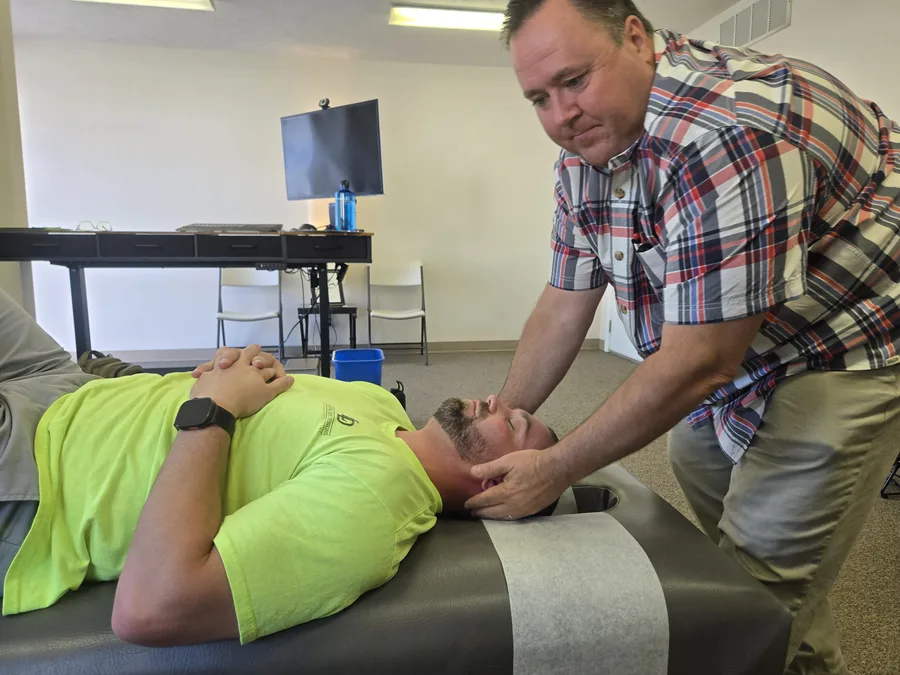
Built for the aches the floor creates.
Backs, necks, shoulders, hips, and the overuse strain that quietly drains a shift. Dr. McCarley treats it on your property, on a portable table, in ten to fifteen focused minutes per employee.
Activator Advanced and Diversified manual technique, matched to the worker in front of him, not a protocol on a clipboard.